Layout Guide

Laundry Location Trade-Offs

Balancing bedroom proximity, noise control, and utility connections in residential floor plans.

Author: Mark Davis
Date: 2026-07-28
Laundry Location Trade-Offs

Overview and Goals

Deciding where to place the laundry room is one of the most critical spatial decisions in modern residential design. While locating the washer and dryer near bedrooms reduces the physical effort of carrying heavy hampers, it introduces significant acoustic challenges. Conversely, placing the laundry in a basement or garage isolates mechanical noise but increases daily step counts and disrupts household workflow. A successful layout balances these competing priorities by analyzing utility connections, structural reinforcement, and circulation pathways.

Key Circulation Rules

To achieve an optimal balance, designers must follow key circulation rules. First, if a laundry room shares a wall with a quiet zone like a bedroom or home office, structural noise insulation is mandatory. Heavy appliances vibrate during spin cycles, transmitting sound directly through standard framing. Second, second-floor laundry rooms require reinforced floor joists and a dedicated drain pan to mitigate water damage risks. Finally, keeping the laundry room within a short, direct path from primary closets prevents the accumulation of dirty clothes in hallways.

Standard Flow Verification Checklist

  • Verify that the laundry room shares no immediate walls with the master bedroom headboard without double-stud framing or acoustic panels.
  • Ensure the pathway from the main walk-in closets to the laundry room does not cross public entertaining zones like the dining room.
  • Confirm the installation of a floor drain and a safety overflow pan for laundry rooms located on the second floor.

Common Design Scenarios

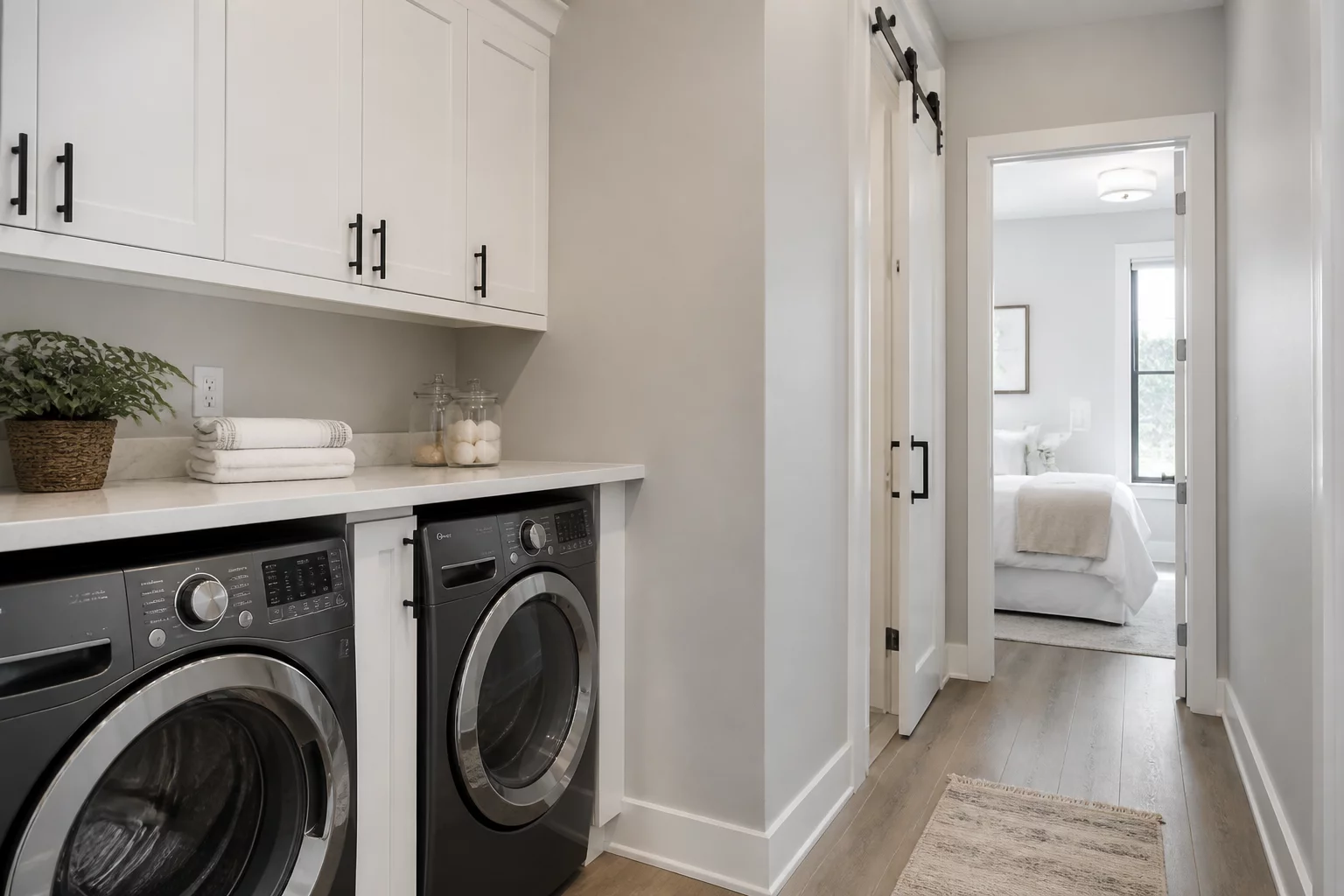
Placing the laundry room on the second floor near bedrooms makes collecting and sorting clothes highly efficient. However, this layout demands careful attention to noise dampening, vibration control, and water damage prevention. If these engineering requirements are met, it serves as a highly functional choice for busy families.

Sound isolation is best achieved by using solid-core doors, double-stud walls, or acoustic insulation inside the wall cavities. Additionally, installing rubber vibration pads under the appliances significantly reduces structural hum during high-speed spin cycles.

Community Review Feed

This could be your first comment. Share your feedback below.

Share Your Layout Feedback